[ Production Tools · Live ]
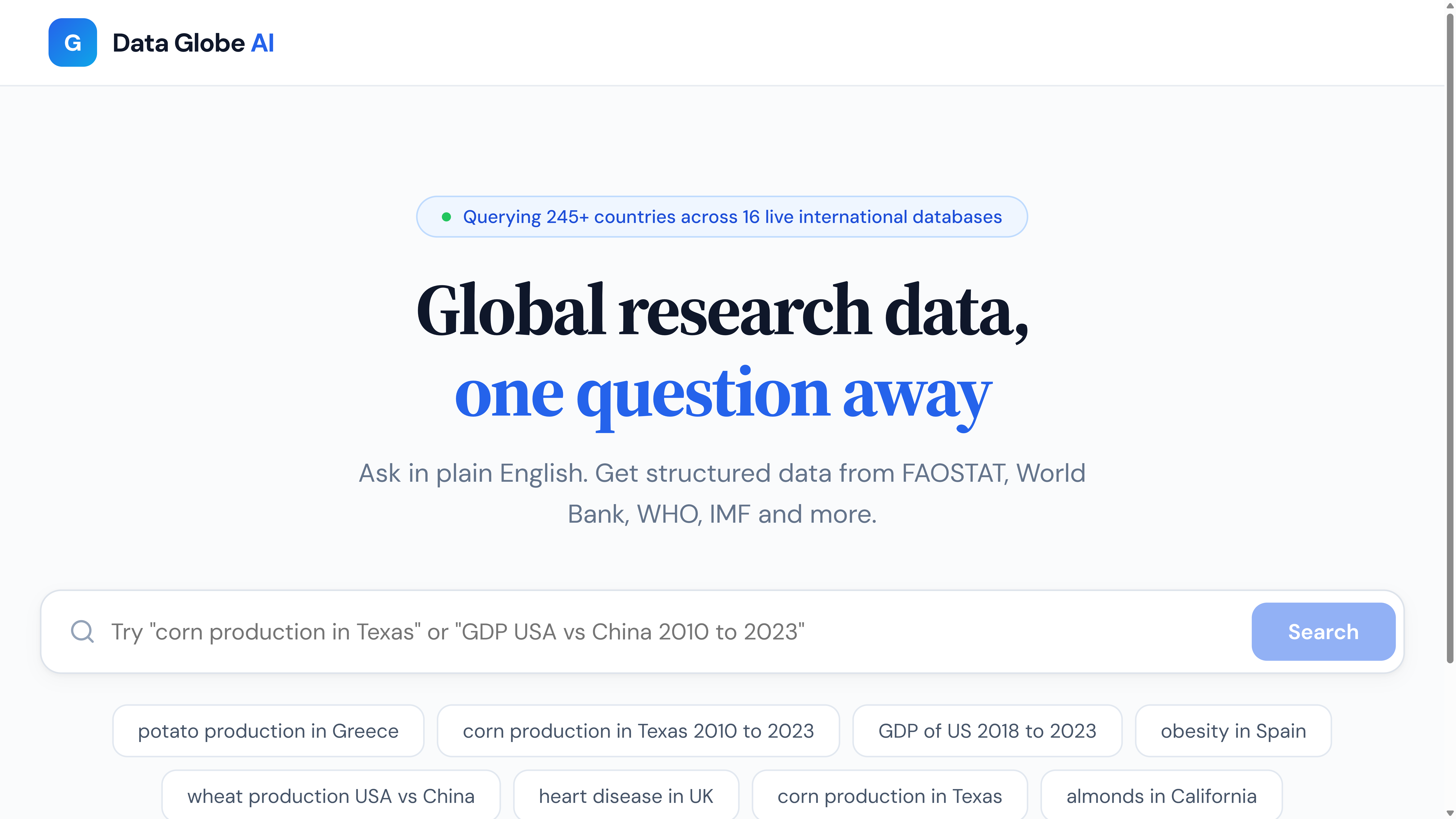
DataGlobe AI is a next-generation research data platform that brings the world's most important international databases into a single, intelligent workspace. With one plain-language query, users can retrieve structured data spanning more than 245 countries and 15 live global databases—including FAOSTAT, the World Bank, the WHO, the IMF, UN Comtrade, and other authoritative sources of socioeconomic, agricultural, environmental, and health data.
For decades, researchers, policy analysts, and decision-makers have faced the same persistent obstacle: the data they need exists, but it is fragmented across dozens of incompatible portals, formats, and access protocols. DataGlobe AI eliminates this bottleneck by combining large language model interfaces with live API connections—compressing what was once a multi-week data engineering task into seconds.
Whether the question is "How has wheat production in North Africa changed over the past decade relative to rainfall trends?" or "What are the latest health expenditure figures across G20 economies?", DataGlobe AI returns clean, structured, citation-ready data within a single conversational session. A foundational step toward democratizing access to global data—and accelerating evidence-based decision-making at the speed of modern research.
[ Key capabilities ]
245+ countries and 15 live international databases unified through a single interface.
Plain-language querying powered by AI.
Structured, citation-ready outputs.
Real-time access through live API integrations.
Designed for researchers, policymakers, journalists, and analysts.
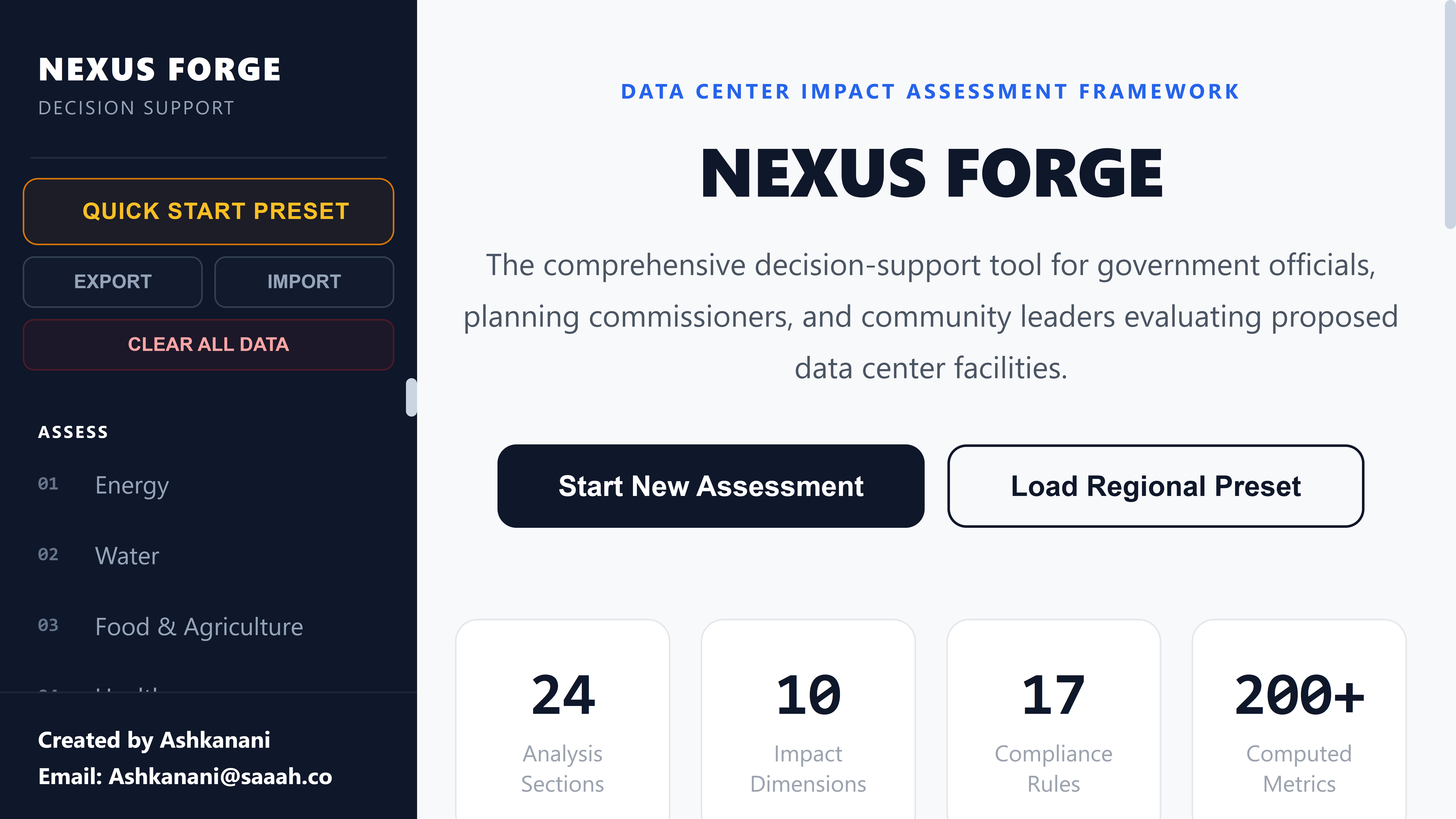
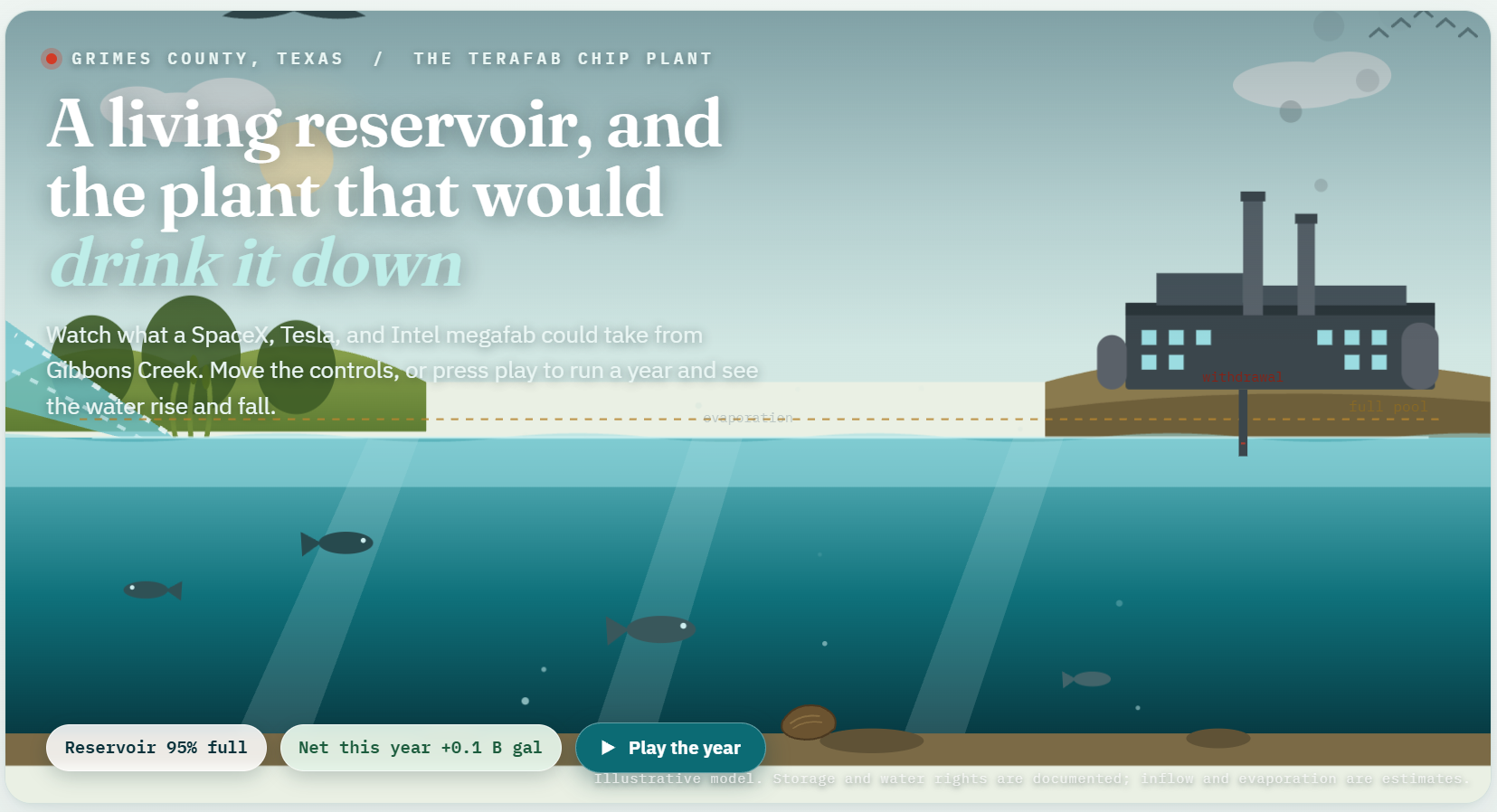
NEXUS FORGE is a frontier decision-support platform built to address one of the most urgent challenges of the AI era: the rapid expansion of large-scale data centers and their growing competition with agriculture, municipal water supply, electrical grids, and land use. As nations race to build AI infrastructure, the resource demands of hyperscale data centers are reshaping regional energy markets, water systems, and agricultural landscapes.
NEXUS FORGE provides the first publicly available tool to model these tradeoffs in an integrated way. The platform applies a Food-Water-Energy-Land (FWEL) Nexus approach, integrating 18 simulation engines with frontier AI surrogate models and NSGA-III multi-objective optimization. It enables planners, utilities, policymakers, and infrastructure investors to evaluate the cascading impacts of proposed data-center developments—and quantify the tradeoffs between economic development and environmental, agricultural, and community priorities.
In a moment when AI infrastructure decisions are being made at unprecedented scale and speed, NEXUS FORGE ensures those decisions can be informed by rigorous, integrated, and transparent analysis—including environmental justice and water-scarce community considerations.
[ Key capabilities ]
First integrated FWEL Nexus tool for data-center impact assessment.
18 simulation engines unified in a single analytical workflow.
Frontier AI surrogate models and NSGA-III multi-objective optimization.
Physics-informed machine learning integrated with policy and economic scenarios.
Built for U.S. Department of Energy Genesis Mission applications.
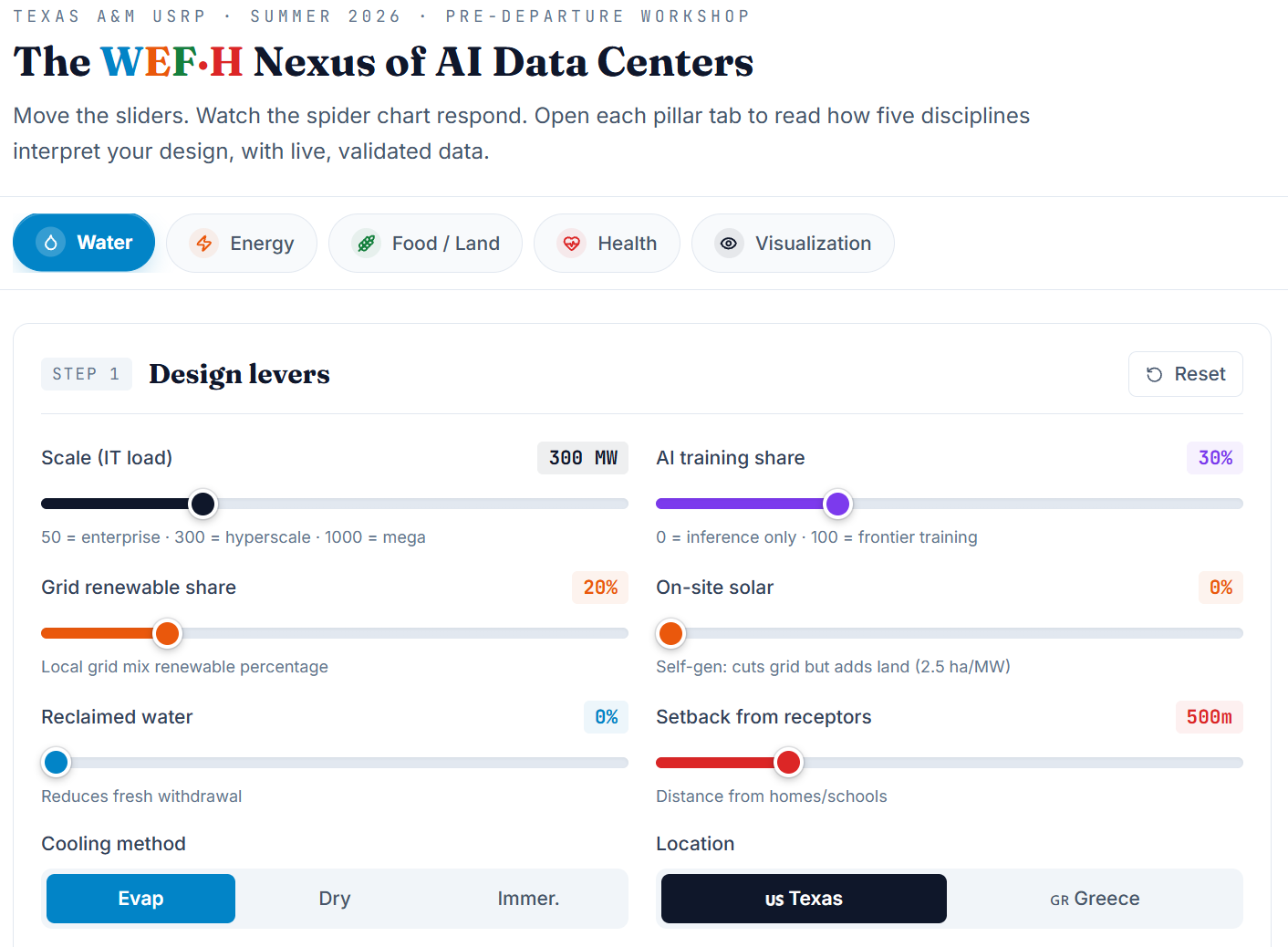
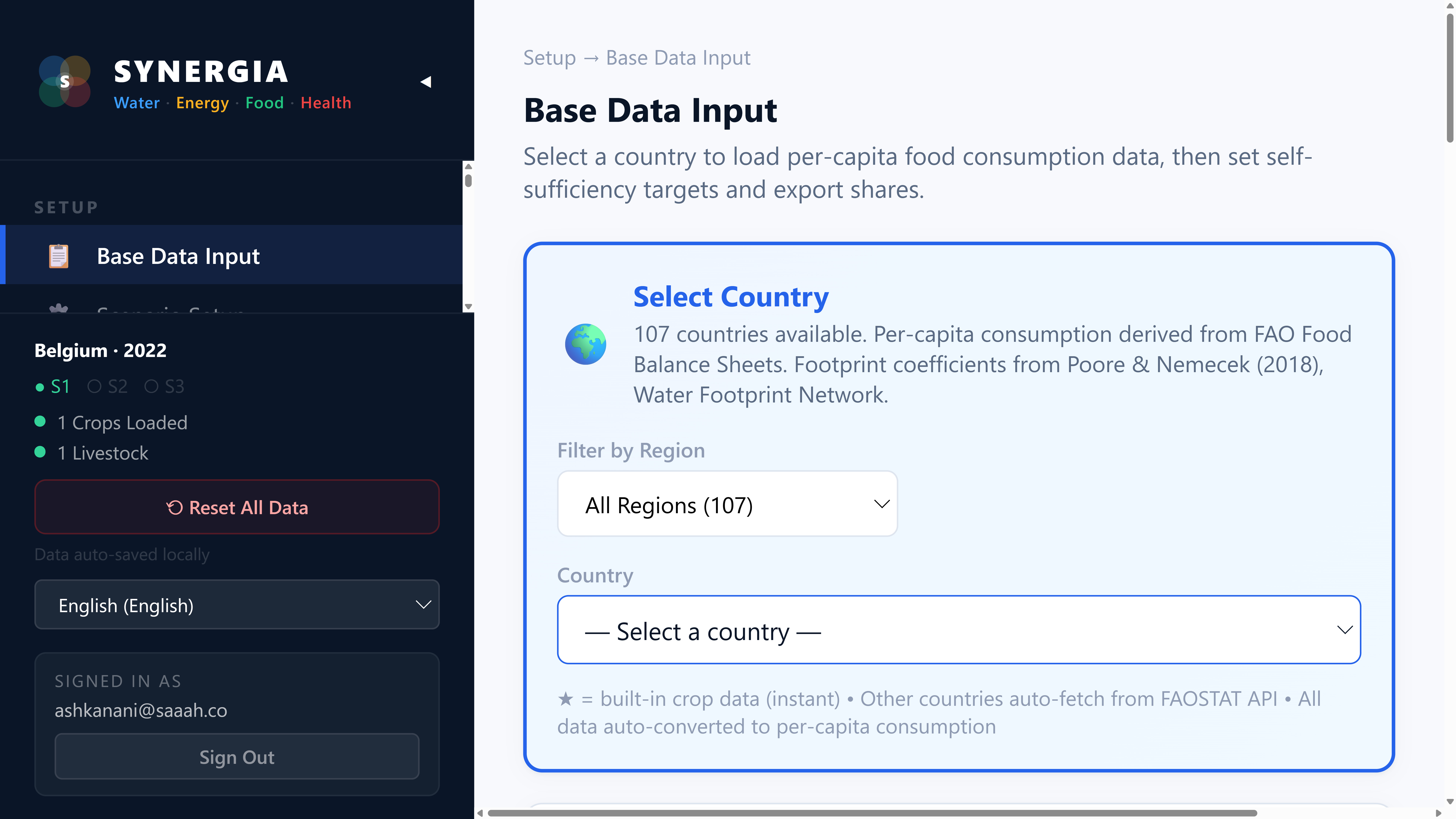
SYNERGIA is the world's first web-based decision-support platform to fully integrate the Water-Energy-Food-Health (WEFH) Nexus into a single analytical environment. It quantifies how policy and resource decisions in one sector cascade into measurable outcomes across the others—giving governments, international agencies, and researchers a previously unavailable instrument for designing integrated, evidence-based sustainability policy.
For decades, the WEF Nexus has been a foundational framework, recognizing that water, energy, and food systems cannot be managed in isolation. But until SYNERGIA, the framework lacked a fourth essential dimension: human health. Climate-driven droughts, energy poverty, food insecurity, and pollution all translate eventually into population health outcomes—yet existing tools have treated health as an externality rather than as a system to be modeled directly. SYNERGIA changes this by embedding Global Burden of Disease (GBD) health pathways into the core of its analytical engine.
The platform integrates multi-objective optimization, climate-scenario modeling, dynamic feedback loops, and AI-powered policy analysis. Users can simulate the downstream effects of agricultural subsidy reforms, energy transitions, water reallocation policies, and climate adaptation strategies—observing in real time how each decision propagates through interconnected resource and health systems. It transforms the WEFH Nexus from an abstract conceptual framework into an operational instrument for real-world governance.
[ Key capabilities ]
First operational platform to integrate Health into the WEF Nexus.
Multi-objective optimization and climate-scenario modeling.
Dynamic feedback loops capturing cross-sector cascading effects.
Global Burden of Disease health pathways embedded in the core engine.
AI-powered policy analysis for evidence-based national decision-making.
[ Build with us ]
Every tool we ship starts with a partner who needed something that didn't exist yet. Tell us what you're trying to figure out—we'll tell you what's possible.
Get in touch